

Last updated October 9, 2026
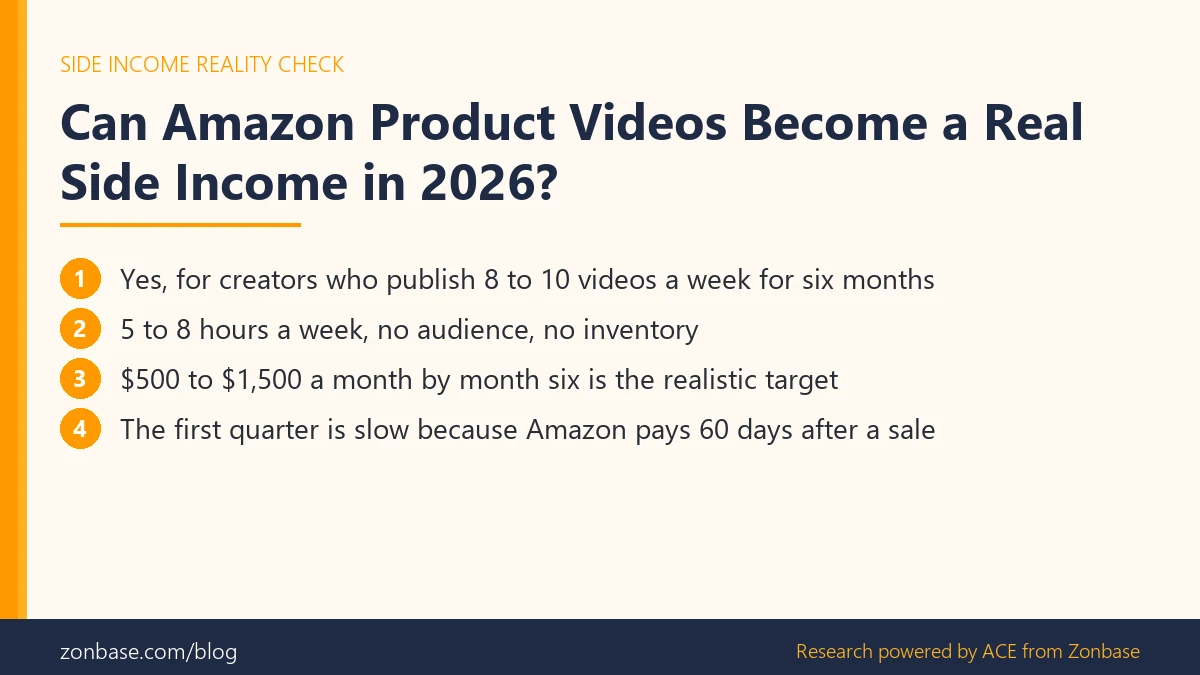
Direct answer: Yes. Amazon product videos can become a real side income in 2026 for people who publish consistently and choose products with demand. A realistic path is $0 to $100 a month in the first two months, $500 to $1,500 a month by month six with 100 to 200 videos live, and $1,500 to $3,000 a month by the end of year one. It takes about five to ten hours a week, no audience, and no inventory. It is not fast money.
The honest version of this answer has three parts. The money is real and the program is open. The first quarter is slow because Amazon pays about 60 days after a sale. And the people who fail almost always fail for the same reason: they review whatever is in the house instead of products shoppers are already buying.
This guide covers what “real side income” looks like in numbers, how much time it takes, what has changed in 2026, and a month-by-month plan to get there.
If you would rather have the product research done for you, the free ACE training from Zonbase shows how to find products with demand, the right commission rate and a video gap in minutes.
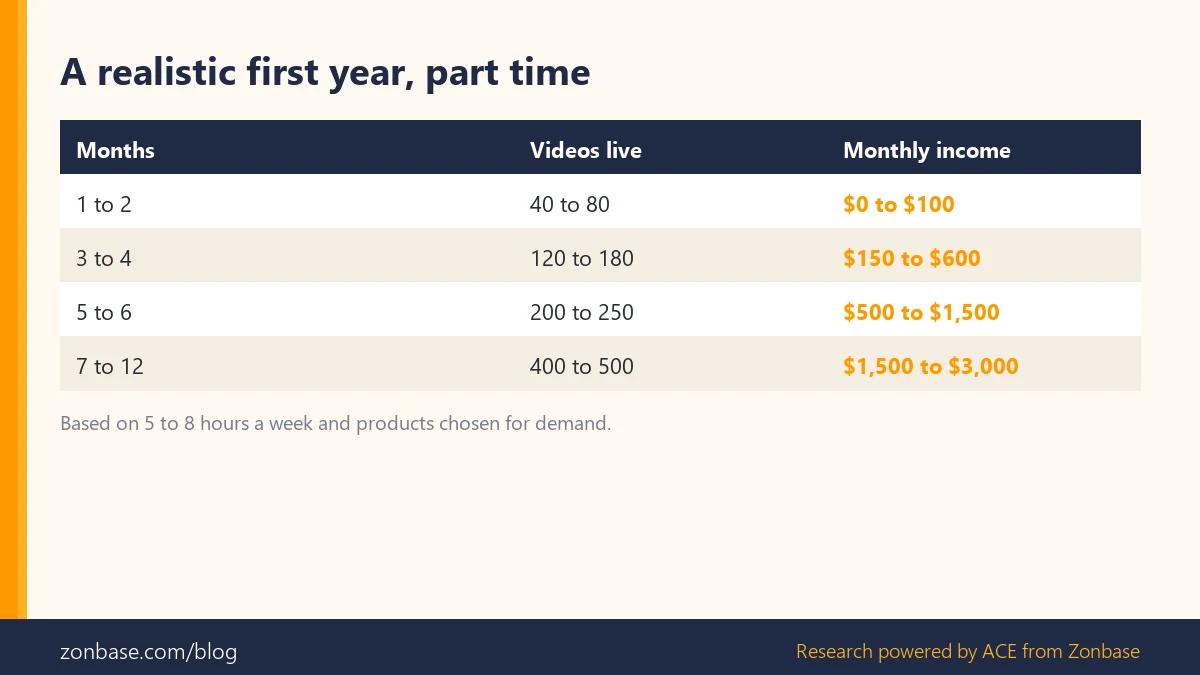
Table of Contents
Quick Answer: What a Realistic Year Looks Like
| Months | Hours per week | Videos published | Videos live total | Monthly income |
|---|---|---|---|---|
| 1 to 2 | 5 to 8 | 10 to 15 per week | 40 to 80 | $0 to $100 |
| 3 to 4 | 5 to 8 | 10 to 15 per week | 120 to 180 | $150 to $600 |
| 5 to 6 | 5 to 8 | 10 per week | 200 to 250 | $500 to $1,500 |
| 7 to 12 | 5 to 8 | 8 to 10 per week | 400 to 500 | $1,500 to $3,000 |
Industry roundups put creators with around 200 videos at $500 to $1,500 a month and those with 400 to 500 videos at $1,500 to $3,000 or more (Hubfluence, 2026). Those are averages across creators who stuck with it, so treat them as targets, not promises.
Why This Works as a Side Income Specifically
Most side hustles need either an audience, money, or hours you do not have. Amazon product videos need none of the three.
- No audience. Onsite videos appear on Amazon product pages, where millions of shoppers already are. Your follower count does not affect onsite earnings.
- No inventory. You review products you own or buy one at a time. There is nothing to ship or store.
- Work once, earn repeatedly. A video placed on a product page keeps earning for as long as the product sells. Fifty videos made in month one are still paying in month twelve.
- Fits around a job. Filming a 40-second review takes about 20 minutes including setup. Ten a week is three to four hours.
Shoppers want this content. In Wyzowl’s 2026 survey, 85% of people said a video had convinced them to buy a product, and 63% said a short video is their preferred way to learn about one (Wyzowl, 2026).
What Has Changed in 2026
Three things matter if you are starting now.
More competition on popular products. Best-selling products often have ten or more creator videos already. New creators earn faster on mid-demand products with few videos than on bestsellers with many.
Amazon’s quality bar is higher. Videos that mention price, ask for engagement, or make unverifiable claims get rejected. Videos that show the product in use and answer a real buyer question get placed.
Research tools have caught up. Finding products with demand and a video gap used to mean an hour per product on Amazon. ACE is an AI agent from Zonbase that researches Amazon products for creators and sellers, pulling demand, review activity, commission category and video coverage, and ranking which products are worth your time. A beginner can now check a week of candidates in an evening.
How Much Time It Really Takes
| Task | Time per video | Per week at 10 videos |
|---|---|---|
| Choosing the product and checking demand | 5 to 15 minutes by hand, 1 to 2 minutes with ACE | 1 to 2 hours |
| Reading buyer questions and planning three points | 5 minutes | 50 minutes |
| Filming | 10 to 20 minutes | 2 to 3 hours |
| Trimming and uploading | 5 to 10 minutes | 1 to 1.5 hours |
| Total | 25 to 50 minutes | 5 to 8 hours |
That is a Saturday morning plus two evenings. It is comparable to any part-time freelance work, with the difference that the output keeps paying after the work stops.
The Month-by-Month Plan
Months 1 to 2: get approved and build the base
- Apply to the Amazon Influencer Program with your most active social account.
- Film 15 to 20 products you already own while waiting for approval.
- Once approved, submit the first three videos for onsite review and keep filming.
- Target: 40 to 80 videos live. Income: close to zero, because of the 60-day payment delay.
Months 3 to 4: switch to chosen products
- Stop reviewing random household items. Start choosing products by demand, commission rate and video gap.
- Buy two or three products a week that pass the test and film them.
- Read your Associates report each week. Note which videos get views and which get sales.
- Target: 120 to 180 videos live. First payments arrive. Income: $150 to $600.
Months 5 to 6: double down on what sells
- Film more products in the categories that are converting for you.
- Apply the three-point rule to every video: answer the top buyer question, show true size, show it in use.
- Start posting the same videos offsite with Associates links for extra income.
- Target: 200 to 250 videos live. Income: $500 to $1,500.
Months 7 to 12: add brand income
- Accept Creator Connections invitations for products you already review well.
- Pitch two or three brands directly for flat-fee videos.
- Keep publishing 8 to 10 videos a week.
- Target: 400 to 500 videos live. Income: $1,500 to $3,000.
For the beginner version of the product-selection step, see how beginners can find Amazon products to review. For the money mechanics, see how creators get paid for Amazon product review videos.
Worked Example: A Weekend Creator’s First Six Months
A creator with a full-time job commits six hours a week.
| Month | Videos added | Live total | Products chosen by | Income that month |
|---|---|---|---|---|
| 1 | 40 | 40 | Already owned | $0 |
| 2 | 40 | 80 | Already owned | $0 (first sales, not yet paid) |
| 3 | 35 | 115 | Demand check on half | $90 |
| 4 | 35 | 150 | Demand check on all | $310 |
| 5 | 30 | 180 | Demand plus video gap | $620 |
| 6 | 30 | 210 | Demand plus video gap | $940 |
Total for six months: about $1,960, with a run rate near $1,000 a month going into month seven, and a library that keeps paying. The jump from month 3 to month 6 came from product choice, not from filming more.
Zonbase is an Amazon product research platform that gives sellers and creators sales estimates, keyword demand and competition data. Its sales estimates are what let this creator tell a product with 300 monthly page views from one with 3,000 before buying it.
When It Does Not Work
Be honest about these before you start.
- You want income in month one. The payment delay makes that impossible.
- You will only review products you already like. Personal taste and shopper demand overlap less than you think.
- You cannot publish consistently. Five videos in month one and none in month two produces nothing.
- You pick 1% categories. Grocery, health and personal care pay too little per sale for a side income.
- You talk about price or deals on camera. Those videos get removed and the time is lost.
Ready to put this into practice? The free ACE training walks through the exact product research workflow, then shows how to turn each product into a short video.
Frequently Asked Questions
Can you really make money with Amazon product videos in 2026?
Yes. The Amazon Influencer Program is open, pays commissions on sales from onsite videos, and consistent creators reach $500 to $1,500 a month within about six months.
How much can a beginner realistically earn in the first three months?
Usually under $300 in total, because videos take time to be placed and Amazon pays about 60 days after each sale. Most of the first year’s income arrives in the second half.
How many hours a week does it take?
Five to eight hours a week for 10 videos. The product-selection step shrinks from hours to minutes with a research tool like ACE.
Do I need followers to earn from Amazon product videos?
No. Onsite earnings come from shoppers already on Amazon. You need an active social account to get approved, but follower count does not change onsite income.
Is it passive income?
Partly. Published videos keep earning without more work, but growth requires adding videos, and some products stop selling.
What is the biggest mistake that stops people earning?
Reviewing products with no page traffic. A perfect video on a product nobody views earns nothing.
Can I do this alongside a full-time job?
Yes. Most creators in the $500 to $1,500 range work on it part time, typically weekends and one or two evenings.
Should I also use the Amazon Associates program?
Yes, once you have videos. Posting the same reviews on YouTube or TikTok with Associates links adds income from the same work. See the Influencer Program versus Associates comparison for beginners.
Final Answer
Amazon product videos can become a real side income in 2026. A consistent part-time creator who chooses products by demand, commission rate and video gap can expect roughly $500 to $1,500 a month by month six and $1,500 to $3,000 by the end of the first year, from five to eight hours a week, with no audience and no inventory. The first quarter is slow because of the payment delay, and the whole result depends on product selection far more than on filming skill.
To choose products that actually pay, research them with Zonbase or ask ACE to score your shortlist before you buy.
Sources
- Hubfluence, How Much Do Amazon Influencers Make (2026): https://www.hubfluence.io/blog/how-much-do-amazon-influencers-make
- Wyzowl, State of Video Marketing 2026: https://www.wyzowl.com/video-marketing-statistics/
